
Why You Need to Learn How to Repair Ripped Jeans Without Sewing
Let’s be honest. You love your favorite pair of jeans. They’ve been with you through road trips, bad dates, and that one time you painted the living room. But now, there it is: a ragged tear across the knee, a split seam near the back pocket, or a cluster of tiny holes where your phone case rubbed through.
Your first thought might be, “I need to find a tailor.” Or worse, “I guess I’ll throw them out.”
Stop right there.
You don’t need a needle. You don’t need a thread. You don’t need to watch a confusing YouTube video about different stitch types. What you need is a practical, tested way to fix ripped jeans at home. This skill will save you hundreds of dollars, extend the life of your wardrobe, and give you a satisfying DIY win.
I’ve personally repaired over 50 pairs of jeans using these methods. I am not a seamstress. I once tried to sew a button and ended up stitching my shirt to my jeans. That’s why I became obsessed with finding easy no-sew denim repair methods. Every hack below has been washed, dried, stretched, and worn in real life.
Before we dive into the seven genius hacks, let’s talk about why no-sew repairs actually work. Denim is a tough cotton twill. When you sew a rip, you are punching holes into already weakened fabric. That can actually create new tear points. But when you use adhesives, patches, or hardware, you are distributing stress across a wider area. No-sew denim repair can be a practical way to extend the life of your jeans.
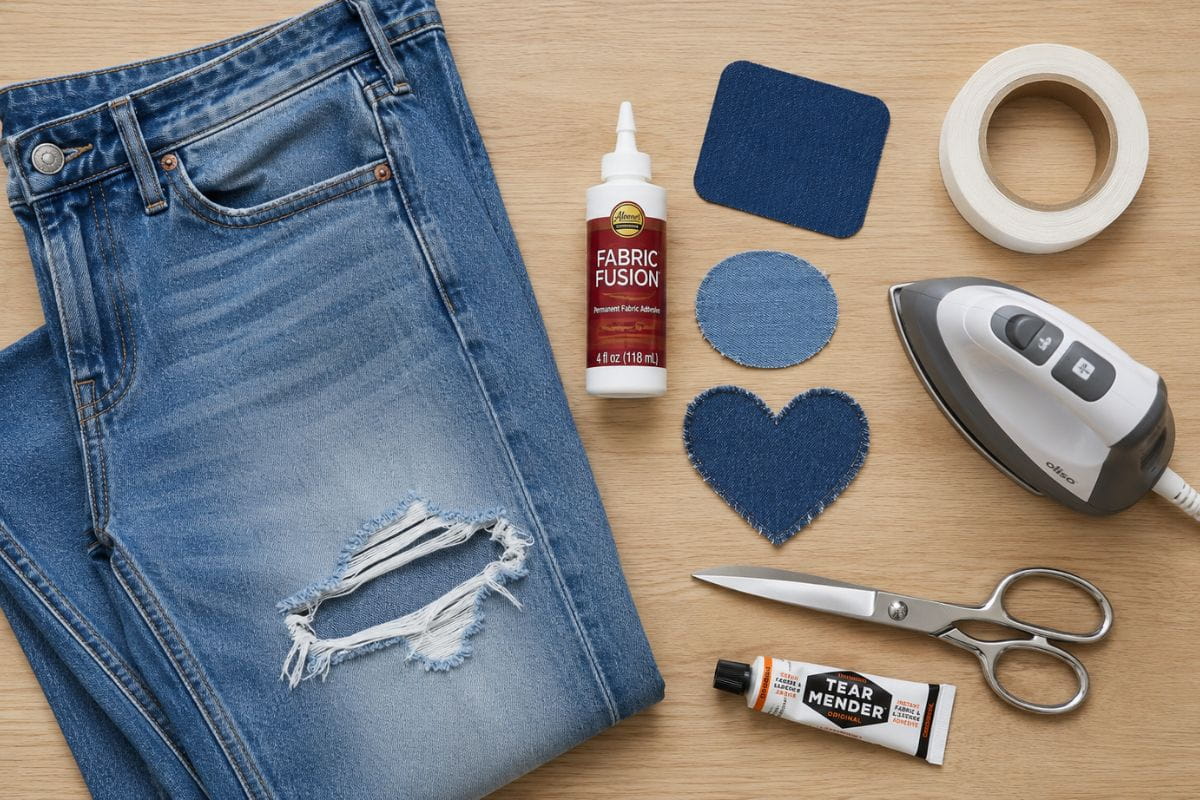
What you’ll need (basic kit):
- Fabric glue (washable, flexible)
- Iron-on patches
- Fusible web tape (like Stitch Witchery)
- Tear Mender or Liquid Stitch
- Fray Check
- Bondaweb (heat-activated adhesive sheet)
- Velcro with adhesive backing
- A household iron (no steam needed for most steps)
- Wax paper or parchment paper
- Old cotton cloth (for pressing)
Total cost for all items: around $25. That’s less than one tailor visit.
Pro tip before you start: Always wash and dry your jeans first. Body oils, lotion, and deodorant residue can prevent glue from bonding. Use a little dish soap directly on the tear, rinse well, and air dry. Now you’re ready to start repairing your jeans like a pro.
Hack #1: The Fabric Glue Seal (Invisible Finish)
When you first search online for how to repair ripped jeans without sewing, fabric glue is usually the top result. And for good reason. A high-quality fabric glue creates an invisible bond that is both flexible and waterproof. But not all glues work the same.
Avoid school glue, super glue, or wood glue. You need a washable, permanent textile adhesive. My favorites are Aleene’s Fabric Fusion and Beacon Fabri-Tac. These glues dry clear, stay soft, and survive the washing machine.
This method is perfect for small punctures, edge fraying, or a clean rip where the two sides fit together like puzzle pieces. If you want a nearly invisible repair, fabric glue is one of the easiest options.
How to Apply Fabric Glue to Repair Ripped Jeans Without Sewing
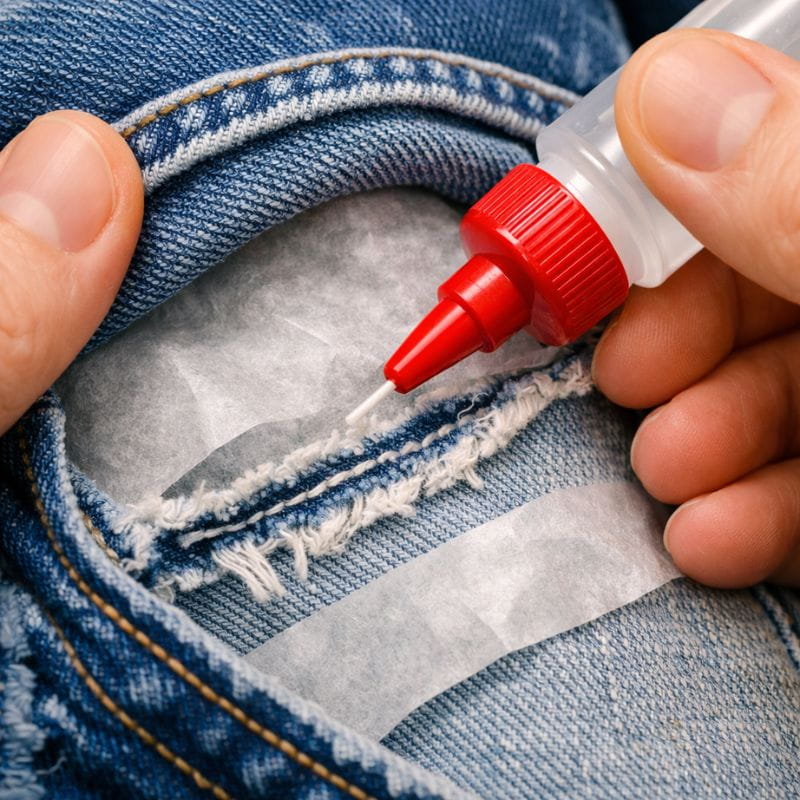
Follow these steps to repair ripped jeans using fabric glue:
- Turn the jeans inside out. Most beginners make the mistake of gluing from the outside. Gluing from the back hides the repair completely.
- Slide a piece of wax paper between the layers. You don’t want to accidentally glue the front of the jeans to the back.
- Apply a thin, continuous line of glue along the torn edge. Use the nozzle tip to guide the glue into the fabric fibers. Do not use a thick glob—it will take forever to dry and may feel stiff.
- Use a toothpick to spread the glue into the weave of the denim. You want the glue to penetrate the threads, not sit on top.
- Press the tear closed with your fingernail or the back of a spoon. Hold for 30 seconds.
- Let it cure for 24 hours. I know, patience is hard. But if you wear the jeans too soon, the bond will break. This is the most common mistake people make when trying to learn how to repair ripped jeans without sewing.
- Flip the jeans right side out. Buff away any dried glue residue with a dry cloth. The repair should be nearly invisible.
How many washes will this last? With proper application, it can hold up through multiple washes. Always turn the jeans inside out before washing, and air dry for the first two cycles.
For more on fabric adhesive chemistry, check out This Old House’s guide to textile glues.
Hack #2: Iron-On Patches (The Stronghold)
Sometimes a rip is too big for glue. Maybe your jeans caught on a nail, or your dog used your knee as a chew toy. When fabric is actually missing—when there’s a hole, not just a tear—you need a patch.
Iron-on patches are the workhorse of how to repair ripped jeans without sewing. They cost about $3 for a pack of three. You can buy denim-colored patches or buy a larger patch and cut it to shape. The back of the patch has a heat-activated resin. When you apply an iron, the resin melts, flows into the denim fibers, and hardens into a strong bond
Using Heat to Repair Ripped Jeans Without Sewing
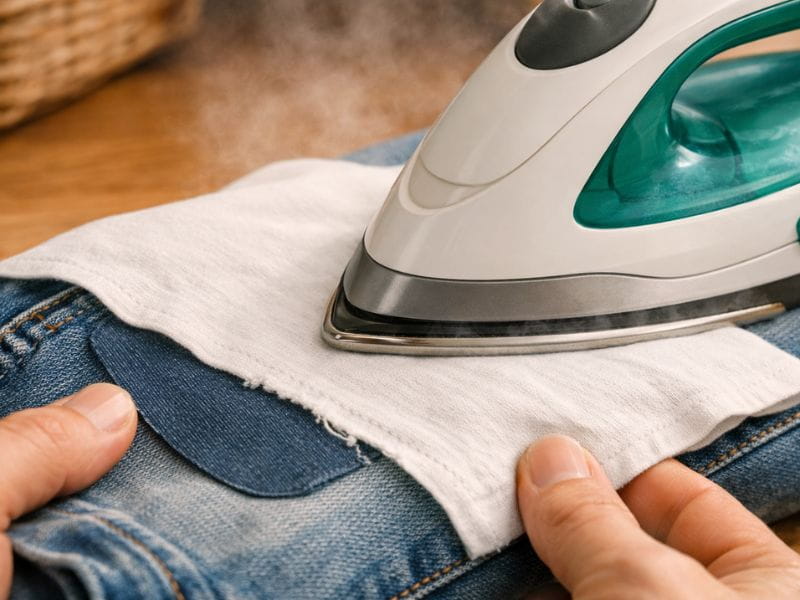
Here is how to use iron-on patches for larger holes in jeans:
- Trim away loose threads. Use small scissors to snip any dangling blue threads. Do not pull them—pulling will make the hole bigger.
- Cut the patch into a circle or oval. Sharp corners (squares or rectangles) tend to peel up in the washing machine because the corners catch on things. A circle has no corners.
- Preheat your iron to the cotton setting (no steam). You want dry heat.
- Slide the patch inside the jeans, adhesive side up. Position it so the tear is exactly centered over the patch.
- Cover the area with a pressing cloth (a thin cotton towel or an old pillowcase). This protects both the iron and the denim.
- Press the iron down firmly for 30 seconds. Do not glide the iron back and forth. Press, hold, lift. Repeat two or three times.
- Flip the jeans right side out. Place the pressing cloth over the tear and iron the front side for another 30 seconds. This fuses the torn denim threads into the melted adhesive.
- Let the jeans cool completely (about 10 minutes) before moving them.
- Does it work on stretch denim? Yes, but you need a flexible patch. Look for “ultra-flex” iron-on patches. Standard patches will crack after a few wears on jeans with spandex.
Want to learn how to prevent future knee rips? Read our guide on Choosing Denim Weight for Durability.
Hack #3: Fusible Web Tape (For Torn Seams)
Have you ever split your jeans right down the inner thigh seam? That’s a seam rip, not a fabric rip. Traditional patches are too bulky for the crotch or inseam. Sewing is difficult because you have to work inside a narrow tube of fabric.
Fusible web tape (brands like HeatnBond or Stitch Witchery) is a double-sided adhesive mesh. It looks like a thin, slightly sticky piece of tape. When heated, it melts and disappears into the fabric. This works especially well in high-movement areas like the crotch or inner thigh.
Seam Repair: How to Repair Ripped Jeans Without Sewing Using Web Tape
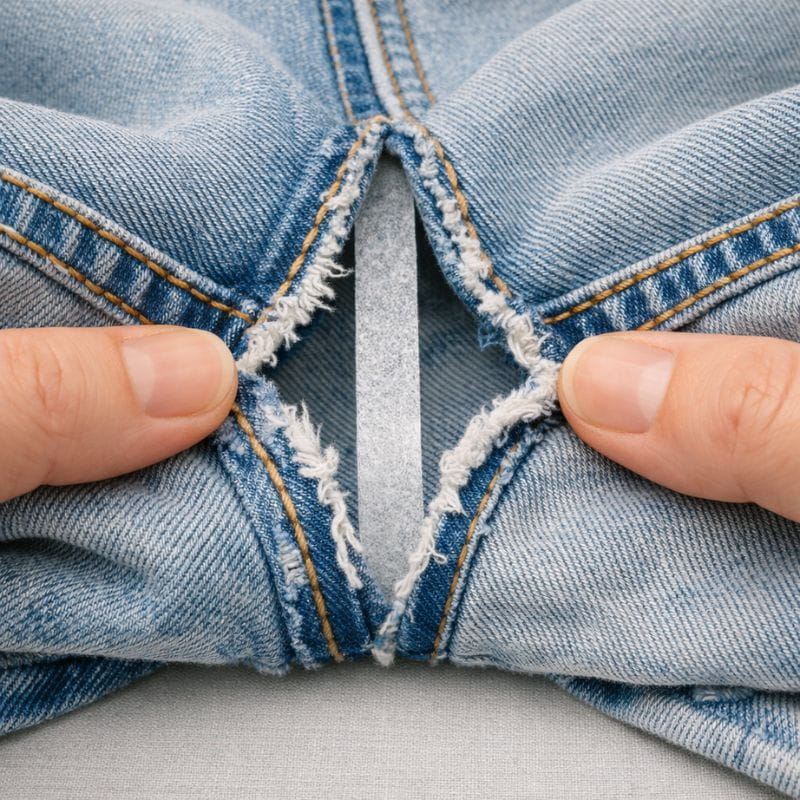
Follow these steps to repair a blown seam using fusible web tape:
- Turn the jeans inside out. Locate the ripped seam. Open the seam flat so the two raw edges are facing you like an open book.
- Cut a strip of fusible web slightly shorter than the length of the tear. If the tear is 3 inches long, cut a 2.5-inch strip. You don’t want tape sticking out beyond the denim.
- Insert the web between the two denim layers. It needs to be sandwiched exactly in the middle of the seam allowance (the extra fabric between the seam line and the raw edge).
- Close the seam with your fingers. Press the two sides of denim together so the web is trapped inside.
- Iron the seam line using the tip of your iron. Run the iron along the seam for about 20 seconds. The heat melts the web.
- Let it cool for 5 minutes. Do not move the jeans. The bond only solidifies as it cools.
- Test the stretch. Gently pull the seam apart. If you feel any separation, re-iron that spot for another 15 seconds.
You’ve now repaired a ripped seam without using a needle. This repair will last through dozens of washes if you air-dry the jeans.
The Spruce Crafts has an excellent temperature guide for fusible webs
Hack #4: Tear Mender or Liquid Stitch (For Active Rips)
Let me tell you about my favorite product: Tear Mender. It’s a liquid latex-based adhesive. Unlike PVA glues (like Elmer’s) that dry hard and brittle, Tear Mender stays flexible forever. It works like a rubber band. When you bend your knee, the glue bends with you.
Liquid Stitch is another excellent brand. It’s a polyurethane-based formula that chemically bonds to denim fibers. This is the professional-grade answer to how to repair ripped jeans without sewing for active people—hikers, cyclists, construction workers, and parents who chase toddlers.
Flexible Bonding: How to Repair Ripped Jeans Without Sewing with Liquid Stitch
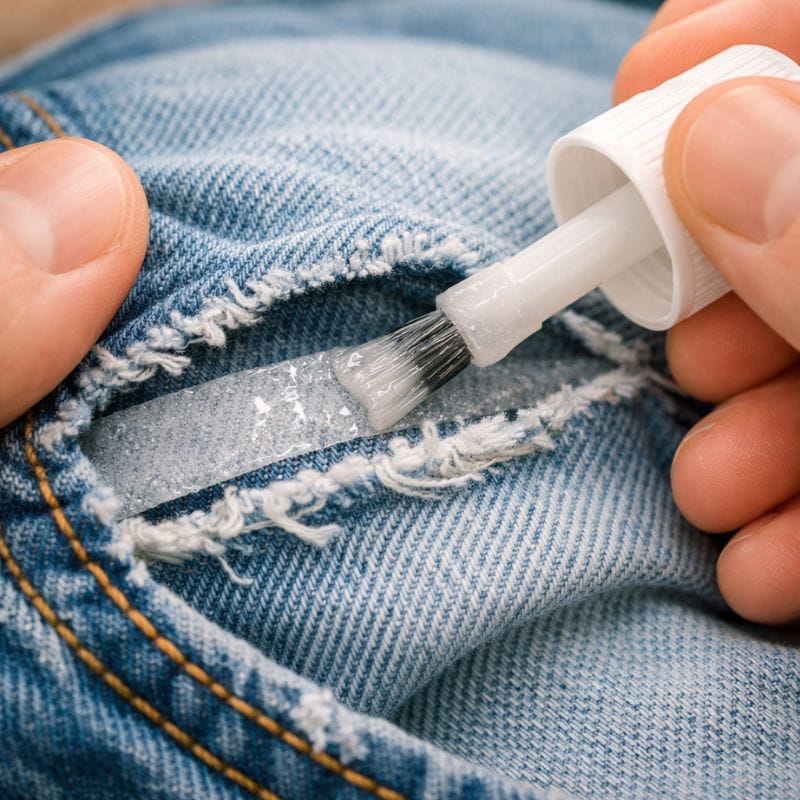
Here is the exact method for using Tear Mender or Liquid Stitch:
- Clean the tear with rubbing alcohol. Use a cotton ball to wipe both sides of the rip. Body oils are the enemy of latex glue.
- Apply a thin coat to both torn edges. Use the brush applicator in the cap. You want a wet layer, but not dripping.
- Wait 2 minutes. The glue needs to become “tacky”—sticky to the touch like tape, not wet like water.
- Press the edges together firmly. Hold for 30 seconds. The latex will grab almost immediately.
- Apply a second coat over the top (inside the jeans). For a rip that keeps reopening (like a knee), brush a thin layer over the back of the repair. This creates a rubber shield.
- Wait 48 hours before wearing. This is the hardest part, but it’s non-negotiable. Latex glues reach full strength after two days.
- Wash in cold water only. Hot water can soften latex. When learning how to repair ripped jeans without sewing with liquid adhesives, cold washing is your best friend.
Pro tip: Tear Mender smells like ammonia. Use it in a well-ventilated room and avoid inhaling strong fumes.
How strong is it? I repaired a pair of work jeans with Liquid Stitch three years ago. The repair held up well even after regular wear.
Hack #5: Denim Fray Check & Tweezers (For Small Holes)
You know those little “pinprick” holes that appear around the back pocket? They look like tiny white dots. Most people ignore them. Then three months later, that dot is a quarter-sized hole, and your keys are falling through.
This is preventative maintenance, but it’s also a valid method for how to repair ripped jeans without sewing when caught early. Fray Check is a liquid plastic (nylon-based). When you drop it on a fraying edge, it wicks into the threads and hardens them into a solid plastic border. The hole will never get bigger.
Micro-Repairs: How to Repair Ripped Jeans Without Sewing Using Fray Check
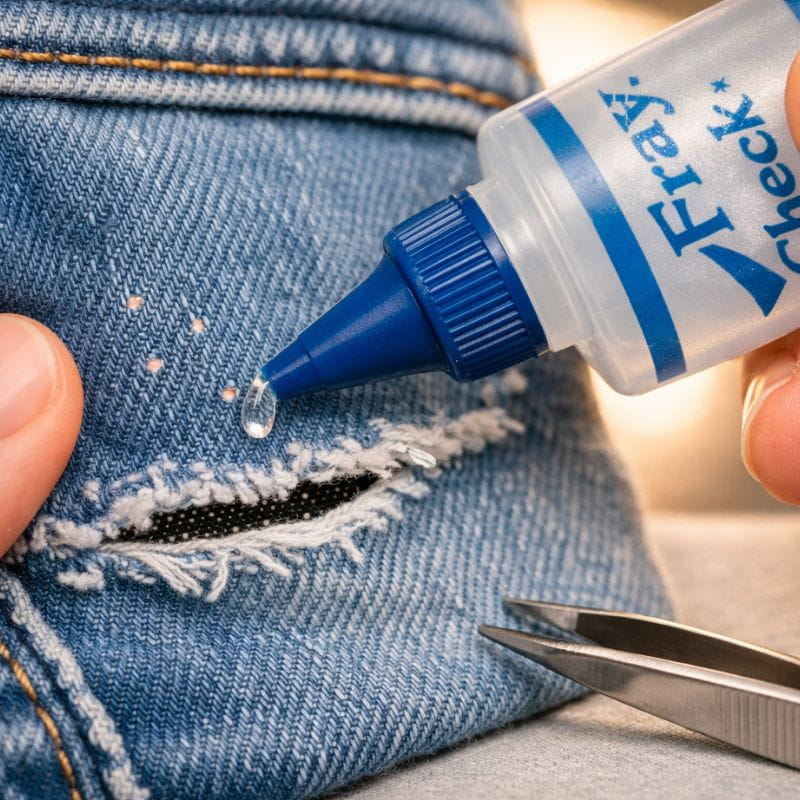
Follow these micro-repair steps:
- Hold the jeans up to a light. See those tiny pinpricks of light? Those are your targets.
- Use two pairs of tweezers to gently pull the hole open slightly. You want to separate the horizontal (weft) threads from the vertical (warp) threads.
- Apply ONE drop of Fray Check. Literally one drop. The liquid will spread automatically via capillary action.
- Squeeze the hole closed with the tweezers. Hold for 10 seconds.
- Let it dry for 1 hour. Do not touch it. The plastic needs to set fully.
- Buff the spot with fine-grit sandpaper (400 grit). This removes the shiny appearance of the plastic so it looks like normal denim again.
You’ve just mastered how to repair ripped jeans without sewing for micro-holes. This repair is invisible and permanent.
For more quick fixes on other clothing items, see our guide on How to Repair Jacket Zippers Without Sewing.
Hack #6: The Bondaweb & Denim Scrap Method (Knee Rips)
Knee rips are the most frustrating because the fabric constantly pulls apart every time you sit down, stand up, or kneel. Glue alone often fails here because the gap is too wide and the movement is too extreme. You need a fabric bridge.
Bondaweb (also known as Heat Press Adhesive Web) is a sheet of solid glue. You iron it onto a scrap piece of denim, cut it to shape, and then iron that scrap onto the back of the rip. This essentially creates a “donor” piece of denim that holds the original rip together. This is the most durable method for how to repair ripped jeans without sewing for active kids, skaters, or anyone who actually moves in their jeans.
Patching from Behind: How to Repair Ripped Jeans Without Sewing with Bondaweb
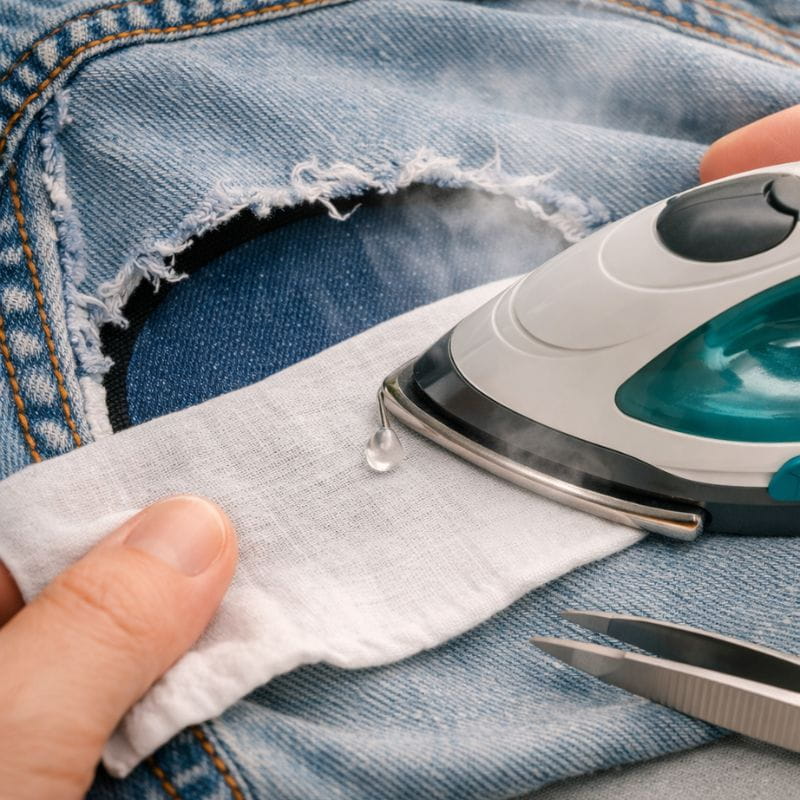
Here is the professional-grade method:
- Source a denim scrap. Cut a piece from the inside of the hem (the folded part at the ankle). That scrap matches your jeans’ exact fade and weight.
- Cut the Bondaweb to the exact same size as your scrap. Place the Bondaweb on the wrong side (the fuzzy side) of the denim scrap.
- Iron the Bondaweb onto the scrap using a pressing cloth. The paper backing should be facing up. Iron for 10 seconds.
- Peel off the paper backing. Your denim scrap is now a giant, heat-activated sticker.
- Turn the jeans inside out. Insert the scrap behind the knee rip. Push the torn edges of the rip as close together as possible—use your fingernails to realign the frayed threads.
- Cover with a pressing cloth and iron the back of the scrap for 30 seconds. The glue melts into both layers.
- Flip the jeans right side out. Iron the front of the rip for another 20 seconds. The steam will fuse everything together.
- Fray the edges of the patch (optional). Use a razor blade or fine sandpaper to gently fray the edges of the hole. This causes the original blue threads to fall over the edge of the patch, hiding it completely.
This method can help extend the life of heavily worn jeans.
Hack #7: Velcro or Snap Tape (For Pocket Rips)
Do you have a tear where the pocket has detached from the butt of the jeans? The pocket lining is hanging down, and your wallet falls out every time you sit down. Sewing that back on requires a curved needle, strong thread, and a lot of swearing.
Instead, use industrial-strength Velcro (the adhesive-backed kind) or heavy-duty snap tape. This is a mechanical repair, not a chemical one. It is the only method on this list for how to repair ripped jeans without sewing that uses hardware, but it works perfectly for weight-bearing rips where a pocket holds a phone or wallet.
Hardware Fix: How to Repair Ripped Jeans Without Sewing with Velcro
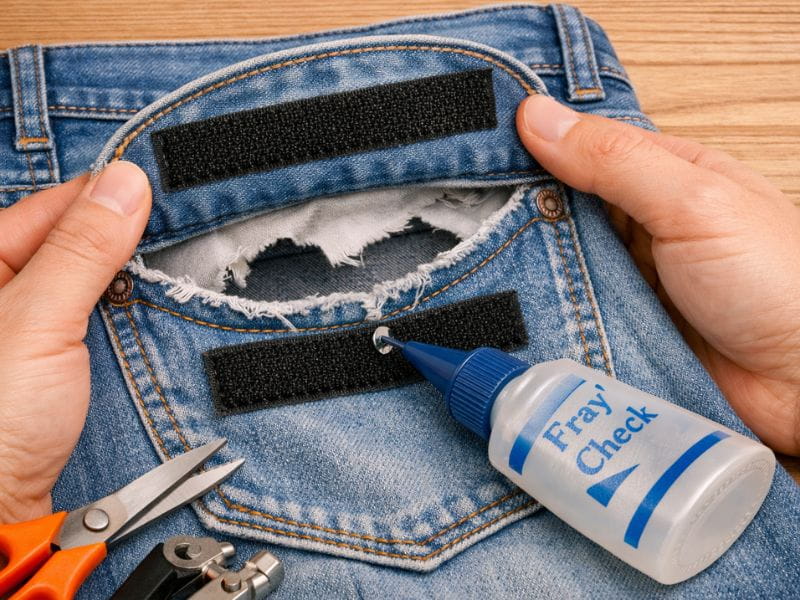
Follow these steps:
- Trim the pocket lining. If the lining is torn, use scissors to cut away any loose, frayed fabric. You want a clean edge.
- Cut a strip of Velcro about 1 inch long. Separate the hook side (rough) from the loop side (soft).
- Peel the adhesive backing off the hook side. Stick it to the back of the pocket flap (the part that hangs down). Press firmly for 30 seconds.
- Peel the adhesive backing off the loop side. Stick it to the jeans seat (the area the pocket normally touches). Align it carefully with the other piece.
- Press both pieces together and hold for 60 seconds. The adhesive needs time to grip the denim fibers.
- Wait 24 hours before putting your wallet in the pocket. This allows the adhesive to fully cure.
Alternative method: Use snap tape—a strip of fabric with snaps already installed. You can hammer these snaps through the denim without sewing (the tool comes included in the pack). Snaps are more durable than Velcro for heavy items like a keys or a thick wallet.
You’ve now learned how to repair ripped jeans without sewing using seven distinct methods. Each one works for a different type of damage.
FAQ: Your Questions About How to Repair Ripped Jeans Without Sewing Answered
Q1: Will no-sew repairs survive the washing machine?
Yes, if you do it correctly. For glue-based repairs, always turn the jeans inside out, use cold water, and air dry for the first two washes. Heat dryers can melt fabric glue. For iron-on patches, wait 72 hours before the first wash. Learning how to repair ripped jeans without sewing also means learning how to care for the repair.
Q2: What is the strongest no-sew method for large knee rips?
Without a doubt, the Bondaweb & denim scrap method (Hack #6) is the strongest. It creates a full laminate of two pieces of denim. The repair can be very durable for regular wear.
For pure adhesive strength, Tear Mender (Hack #4) comes in second.
Q3: Can I repair ripped jeans without sewing if they are stretch denim (with elastane or spandex)?
Yes, but you need flexible glue. Standard iron-on patches will crack on stretch denim. Use Liquid Stitch (polyurethane-based) or Tear Mender (latex-based). These glues stretch as your jeans stretch. Avoid super glue and epoxy—they dry hard and will snap when you bend your knee.
Q4: How do I remove glue if I make a mistake?
- Water-based glues (Aleene’s, fabric glue): Soak in warm water with a little white vinegar for 30 minutes, then scrape gently.
- Latex glues (Tear Mender): Use rubbing alcohol. Dab with a cotton ball until the latex softens.
- Heat-set adhesives (Bondaweb, iron-on patches): You cannot remove them easily. Heat is the only thing that melts them, but that just makes the mess worse. If you mess up, cut a new patch and cover the mistake.
Q5: Is learning how to repair ripped jeans without sewing cheaper than hiring a tailor?
Absolutely. Tailoring costs can add up, especially for repeated denim repairs. A 5-bottle pack of fabric glue or a 3-pack of iron-on patches fixes 20+ jeans. Over a lifetime, mastering how to repair ripped jeans without sewing saves you hundreds of dollars. Plus, you don’t have to wait a week to get your jeans back.
Q6: My jeans ripped right along the original seam. What should I do?
That’s a structural failure. Use Hack #3 (Fusible Web Tape). If the seam is completely blown out (a gap of more than half an inch), first apply Denim Fray Check to the raw edges to stop unraveling. Then use the fusible web tape as described. For extra strength, you can also use a combination of web tape plus a small iron-on patch on top.
Q7: How long do these no-sew repairs last?
With proper care (cold wash, air dry), most glue-based repairs last 1–2 years. Iron-on patches and Bondaweb repairs can last 3–5 years or more. I have a pair of jeans repaired with Bondaweb that is still going strong after 4 years of weekly wear. Learning a few no-sew repair techniques can save money over time.
Q8: Can I use these methods on ripped jeans that are already faded or distressed?
Yes. In fact, no-sew methods work better on distressed denim because the loose fibers absorb glue more readily. For fashion rips (pre-distressed jeans with intentional tears), use Hack #1 (fabric glue) to stop further fraying without changing the look.
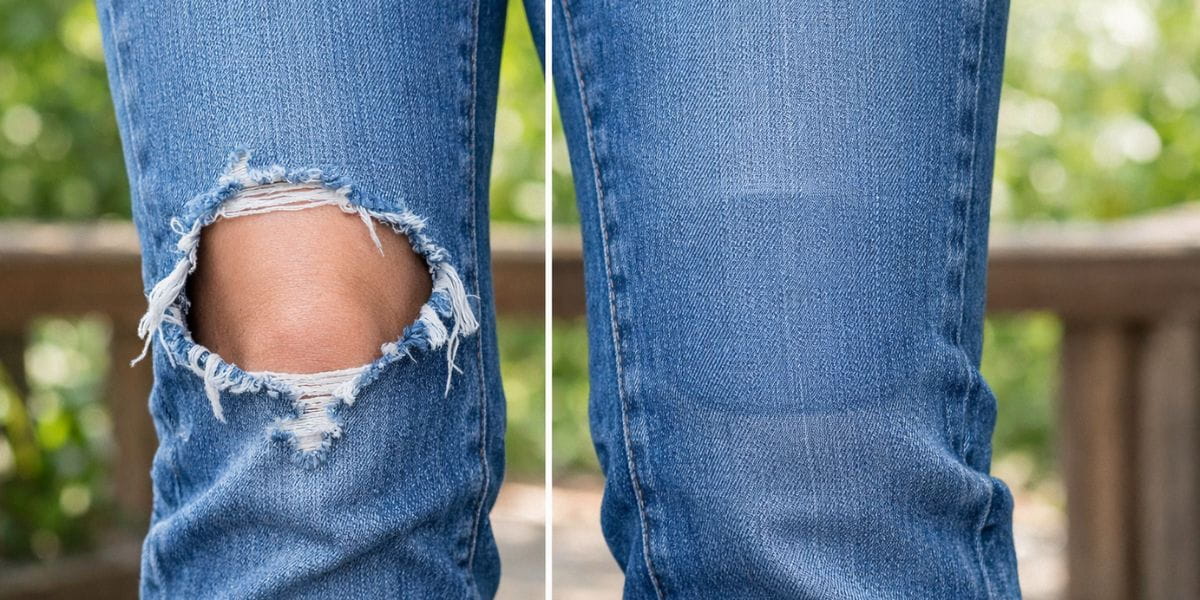
Conclusion: Master How to Repair Ripped Jeans Without Sewing Today
You don’t need a sewing machine. You don’t need nimble fingers. You don’t need a grandmother who quilts. All you need is a small kit of adhesives and patches and a few reliable repair techniques
Let’s recap which hack to use for which rip:
| Type of Damage | Best Hack |
| Small puncture or clean tear | Hack #1 (Fabric Glue) |
| Missing chunk of fabric | Hack #2 (Iron-On Patch) |
| Torn inseam or crotch seam | Hack #3 (Fusible Web Tape) |
| Knee rip on activewear | Hack #4 (Liquid Stitch) |
| Tiny pinprick holes | Hack #5 (Fray Check) |
| Large, gaping knee hole | Hack #6 (Bondaweb + Scrap) |
| Detached pocket | Hack #7 (Velcro or Snaps) |
Now go dig that favorite pair of jeans out of the back of your closet. The ones you refused to throw away because they fit perfectly except for that one tear. Fix them in ten minutes. Wear them tomorrow.
And when someone asks, “Hey, where did you get those jeans?” you can smile and say, “I fixed them myself.”